Article
Why Your FTP Plateaued (And How to Break Through)
![[HERO] Why Your FTP Plateaued (And How to Break Through)](https://cdn.marblism.com/1ZKw_YEdRIo.webp)
You’ve been putting in the hours. You’ve been sweating through every session on the trainer, chasing those virtual avatars, and pushing your heart rate into the red. But when the time comes for your FTP test indoor cycling session, the number doesn't move. Or worse, it drops.
If your Functional Threshold Power has been stuck in the same gear for months, you aren't alone. It’s one of the most common frustrations in the world of structured training. But here’s the reality: most plateaus aren't caused by a lack of effort. In fact, many cyclists are working too hard in the wrong ways.
Plateaus happen when your body stops receiving a novel training stimulus or when you’ve stopped giving it the resources to adapt. To break the ceiling, you need to stop training harder and start training smarter.
The 4 Most Common Plateau Causes
Before you can fix your power numbers, you have to diagnose where the leak is. Most indoor cyclists fall into one of these four traps.
1. The "Grey Zone" Trap
Every ride becomes "medium-hard." You jump on the bike, feel fresh, and decide to "push it" a little. You end up riding in Zone 3, not slow enough to build true aerobic endurance, but not intense enough to trigger significant threshold adaptations. You’re accumulating fatigue without the fitness payoff. This "junk volume" is the primary reason an FTP test indoor cycling result stays stagnant.
2. Progression Stalls
Your body is an adaptation machine. If you do 3x10 minutes at 100% FTP every Tuesday for three months, your body eventually says, "Okay, I can do this now," and stops changing. To keep the needle moving, you must implement progressive overload. If you aren't adding duration, decreasing rest, or bumping up the target wattage, you aren't giving your physiology a reason to improve.
3. Recovery is Underplanned
We don’t get faster on the bike; we get faster while we sleep. If you are constantly chasing "fitness points" or TSS (Training Stress Score) without scheduled deload weeks, your body stays in a state of chronic inflammation. A tired muscle cannot produce maximum power. When you head into your next test, you aren't testing your fitness; you're testing your fatigue.
4. You’re Not Tracking the Right Signals
FTP is just one data point on a massive map of your performance. If you only focus on that single number, you miss the nuances of your Power Duration Curve. Perhaps your 20-minute power is flat, but your 5-minute VO2 Max power has skyrocketed. Without looking at the full picture, you might feel like you're failing when you’re actually on the verge of a breakthrough.
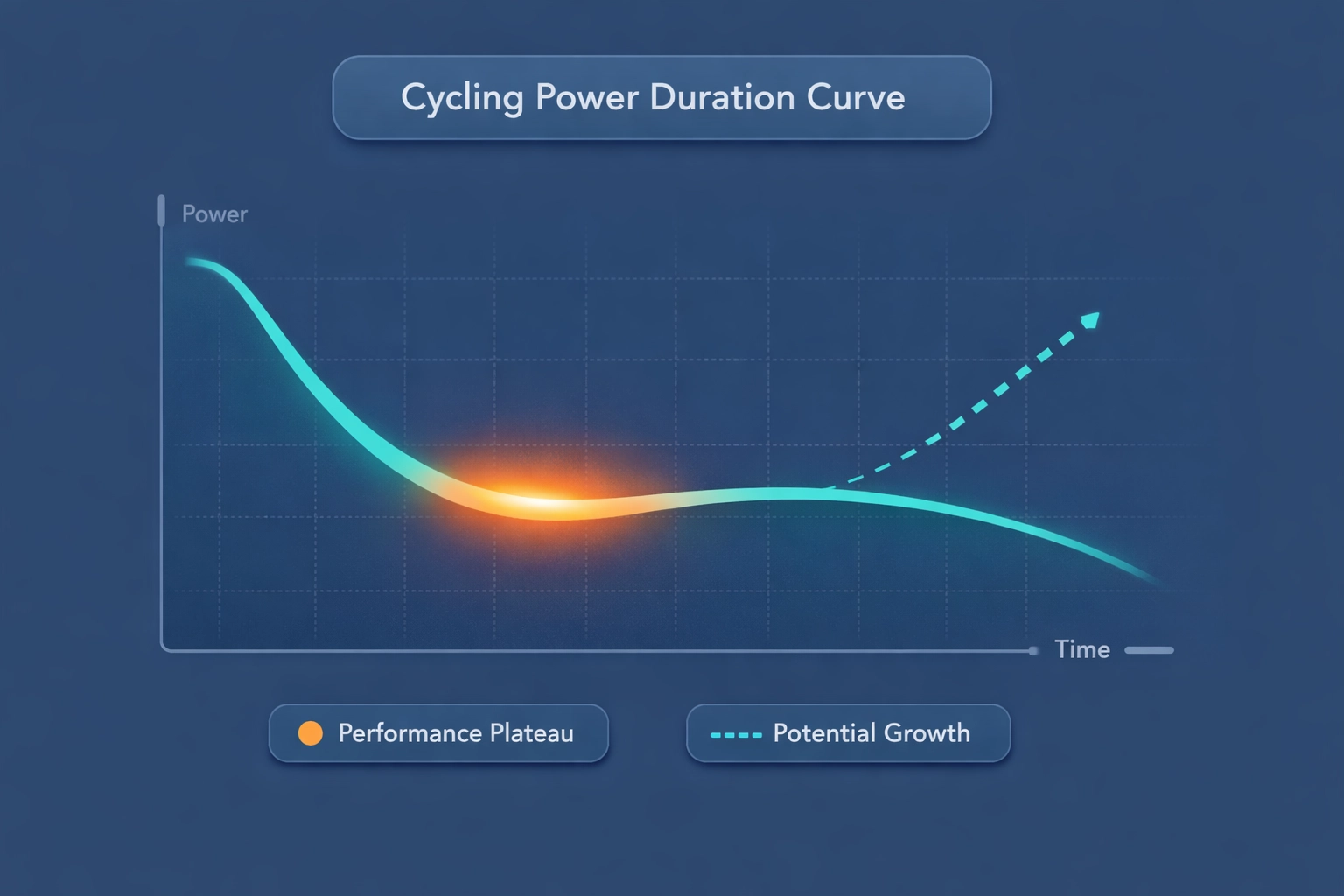
A detailed visualization of a Power Duration Curve, showing the relationship between intensity and duration, highlighting where a cyclist might be "plateauing" versus where they are gaining strength.
The Science of the Breakthrough: High-Volume vs. High-Intensity
To smash a plateau, you often need to shift your focus. Research suggests two primary ways to raise the "ceiling" of your FTP:
- Build the Base (The Aerobic Engine): Sometimes, the reason your FTP won't move is that your aerobic foundation is too small. By increasing your Zone 2 endurance volume, you improve mitochondrial density and fat oxidation. This allows you to support a higher threshold. Use the VeloWorkout library to find longer endurance sessions that don't burn you out.
- Raise the Roof (VO2 Max): Your FTP is usually a percentage of your VO2 Max (your maximum aerobic capacity). If your FTP is already at 85-90% of your VO2 Max, it has nowhere left to go. You need to perform "supra-threshold" intervals: short, sharp efforts at 110-120% of FTP: to pull your overall capacity upward.
A Simple 4-Week Progression Model
Consistency is the king of cycling, but variety is the queen. Follow this 4-week block to shock your system back into growth.
Week 1: Establish Your Baseline
Start with a workload you know you can handle. Focus on "Interval Density": the amount of time spent at your target intensity. If your goal is to improve threshold, aim for 30–40 minutes of total work (e.g., 4x10 minutes).
Week 2: Add Interval Duration or Intensity
Push the boundaries. Take those 10-minute intervals and turn them into 12 or 15-minute blocks. Alternatively, keep the duration the same but reduce the recovery time between sets. This forces your body to clear lactate more efficiently.
Week 3: Peak Load
This is your hardest week. Keep the quality high. This is where you might incorporate a Sweet Spot session to maximize the training effect without the massive fatigue of a pure VO2 Max day. Raise the load slightly higher than Week 2.
Week 4: Deload and Absorb
Crucial: Cut your volume by 40-50%. Keep the intensity high but make the intervals very short. This "flush out" week allows your body to finally repair the damage from the previous three weeks. By the end of this week, you should feel "snappy" and ready for your next FTP test indoor cycling attempt.
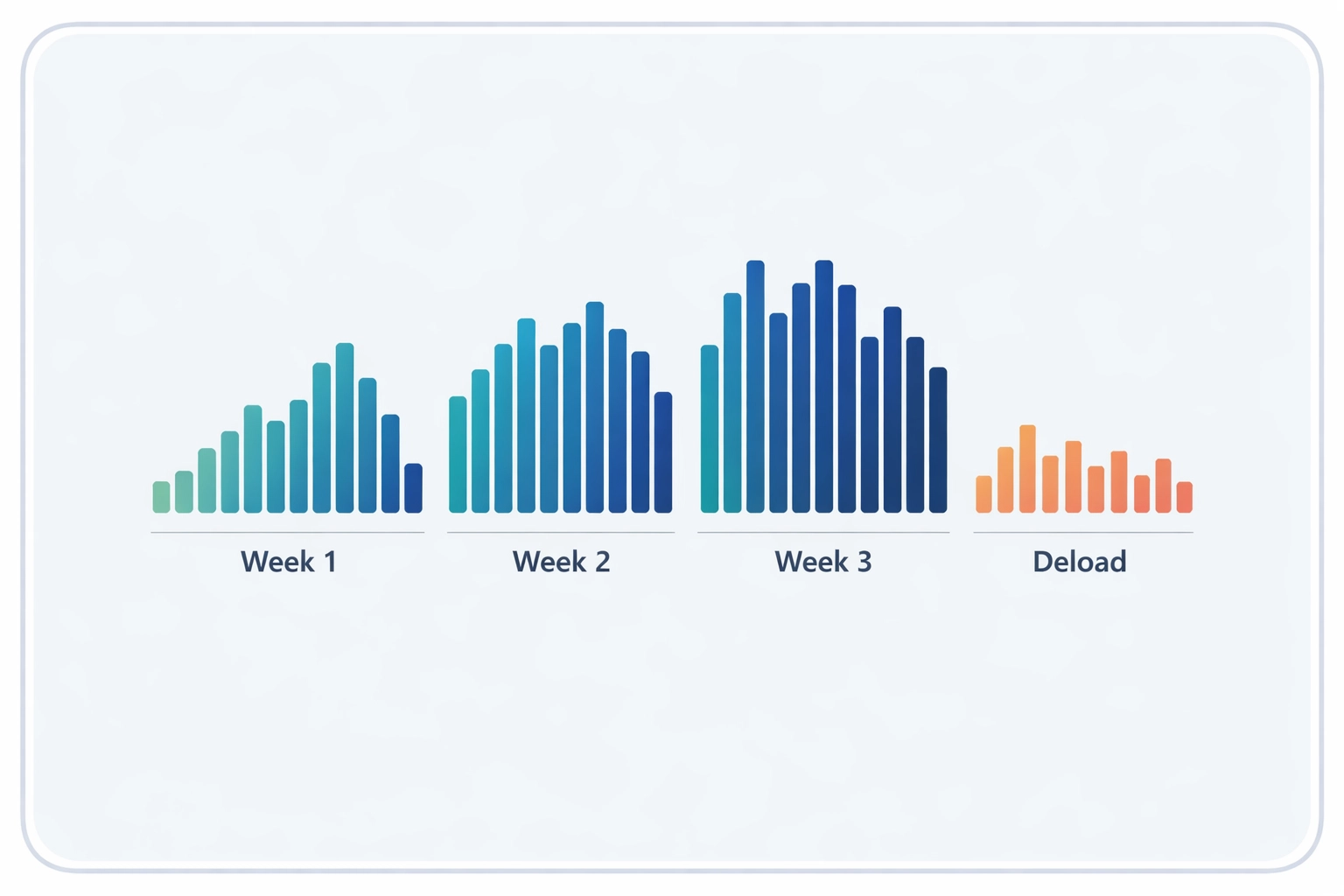
The VeloWorkout Builder interface, showing a structured 4-week training block with varying intensities and a clear deload period.
How VeloWorkout Helps You Break the Plateau
You shouldn't need a degree in sports science to get faster. VeloWorkout is designed to take the guesswork out of the equation so you can focus on the pedals.
Build Targeted Sessions Fast
Don't just "ride." Use our workout builder to craft specific threshold and VO2 Max sessions. You can drag and drop intervals to create a progressive plan that actually challenges your current limits.
Track Trends, Not Just Tests
Our performance analytics allow you to see your power curve trends over time. Instead of waiting for a monthly FTP test, you can see if your 1-minute, 5-minute, or 60-minute power is improving ride-by-ride.
Balanced Weekly Load
VeloWorkout helps you keep your weekly load balanced. By visualizing your history and upcoming sessions, you can ensure you aren't falling into the "Grey Zone" trap. You'll see exactly when you’ve done too much and when it’s time to back off.
Life-Proof Training
Plateaus often happen because life gets in the way of consistency. Our platform makes it easy to adjust your plans when work, family, or travel disrupts your schedule. Flexibility is the key to long-term progress.
Tackle Your Next FTP Test with Confidence
A plateau is not a dead end; it’s a signal that your current strategy has reached its limit. It’s an invitation to evolve.
By avoiding the "Grey Zone," embracing progressive overload, and prioritizing your recovery, you provide your body with the environment it needs to grow. Stop repeating the same mistakes and start using the data to your advantage.
Ready to see what you're truly capable of? Discover how our structured plans can help you navigate your way out of the plateau and toward your next personal best. Build your engine, track your progress, and crush your next FTP test indoor cycling session.
The road to a higher FTP starts with a better plan. Let's get to work.
Turn your training plan into actual progress
Build workouts, execute with smart trainer support, and track performance with data that matters.
Open VeloWorkout