Article
Structured Cycling Training for Beginners: Stop Guessing, Start Gaining
![[HERO] Structured Cycling Training for Beginners: Stop Guessing, Start Gaining](https://cdn.marblism.com/HJG1iPVyab7.webp)
Stop "just riding." If your current strategy involves hopping on the bike, pedaling until your legs burn, and hoping the numbers on your head unit go up next week, you’re stuck in the "junk mile" trap. You’re working hard, but you aren’t working smart.
The difference between a cyclist who plateaus and one who consistently hits new PRs isn't just "grit": it's a structured cycling training plan.
Structure takes the guesswork out of the equation. It replaces "I think I’ll go hard today" with "I will perform four 8-minute intervals at 95% of my FTP." It transforms your sweat into measurable progress. Whether you are training for your first 100km or just want to stop being dropped by the local group ride, shifting to a structured approach is the single most effective move you can make.
The Myth of the "Perfect" Static Plan
Most beginners start by downloading a static 12-week PDF. It looks great on paper: Monday rest, Tuesday intervals, Wednesday endurance. But then life happens. You stay late at work, the kids get sick, or you just wake up feeling like a lead weight.
When you miss a session in a static plan, the "overwhelm" kicks in. You feel like you’ve failed the plan, so you try to "make up" for it by smashing a double workout on Thursday. This is a fast track to burnout and injury.
At VeloWorkout, we believe a cycling workout plan should work for you, not the other way around. Real progress happens when you have a plan that is flexible enough to adapt to your life while remaining rigorous enough to force physiological adaptation. Instead of a rigid calendar, think of your training as a series of building blocks. If a block moves, the foundation stays solid.

Why Structure Beats "Just Riding" Every Time
When you ride without a plan, you tend to gravitate toward "moderate" intensity. It’s that middle ground: too hard to be recovery, too easy to trigger major fitness gains. It feels like effort, but it yields diminishing returns.
A structured cycling training plan polarizes your efforts. It forces you to go truly easy on recovery days so that you have the metabolic "fuel" to go absolutely savage on your HIIT cycling workout days. This push-and-pull is what forces your body to adapt, increasing your stroke volume, capillary density, and lactate threshold.
The 3-Day Framework: Your First Structured Week
You don’t need to ride six days a week to see massive gains. In fact, for most beginners, three high-quality, structured sessions are far superior to six days of aimless wandering. Here is the framework we recommend for those starting an indoor cycling training plan.
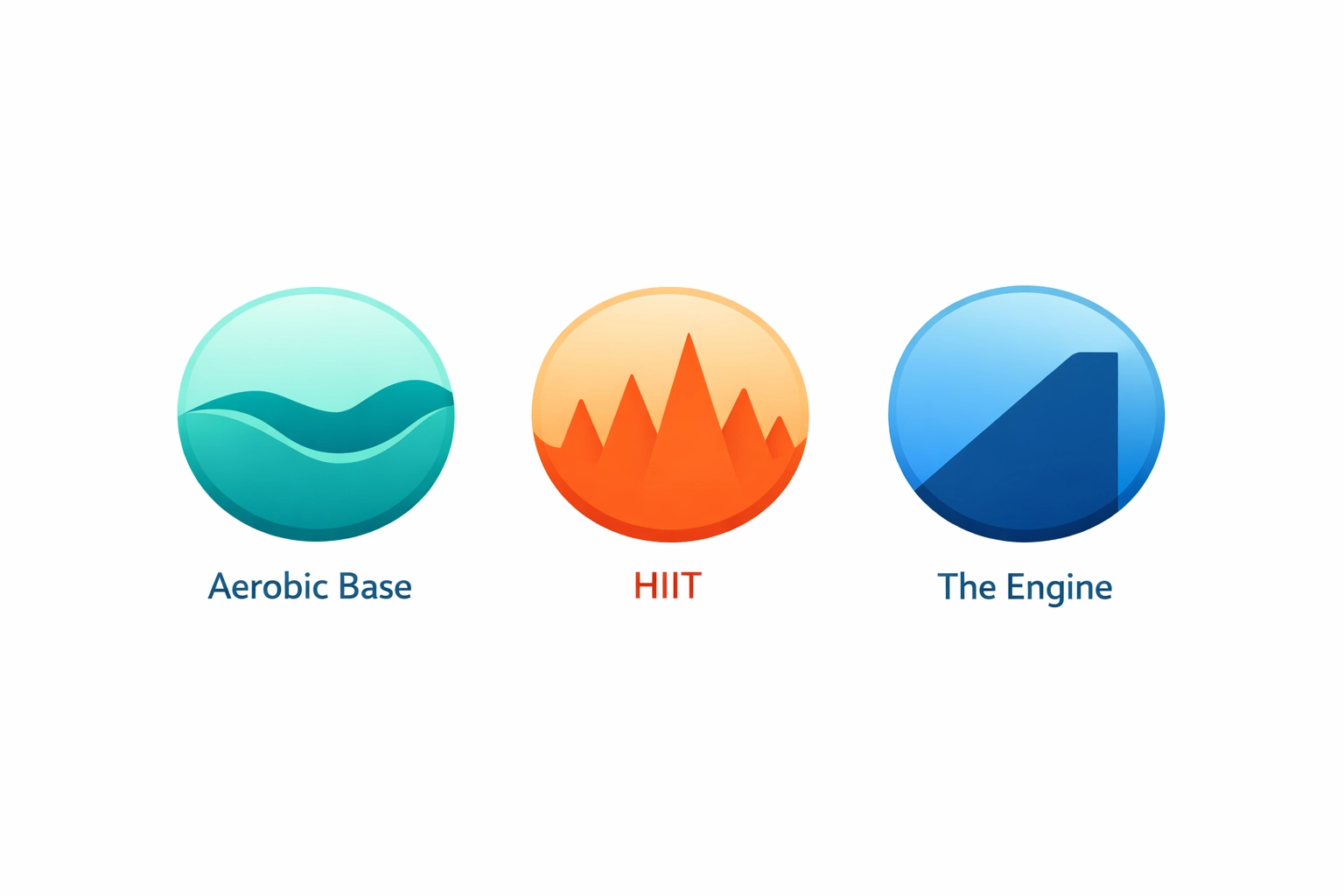
1. The Foundation: Aerobic Base (60–90 Minutes)
The Goal: Build endurance and teach your body to burn fat efficiently. The Effort: Zone 2. You should be able to hold a conversation, though you might be breathing a bit more heavily. Why it works: This builds the "engine" size. Without a solid base, you can't support the high-intensity efforts. Don't skip this. It might feel "too easy," but it’s the bedrock of your fitness.
2. The Spark: HIIT Cycling Workout (45–60 Minutes)
The Goal: Raise your ceiling and improve VO2 Max. The Effort: Short, sharp bursts (30 seconds to 2 minutes) at 110-120% of your FTP, followed by equal rest. Why it works: High-Intensity Interval Training (HIIT) packs a massive punch for a short time investment. It’s the most "bang for buck" session in your arsenal.
3. The Engine: Interval Training Cycling (60 Minutes)
The Goal: Increase your "Steady State" power or Sweet Spot. The Effort: Longer intervals (8–15 minutes) at 88-94% of your FTP. Why it works: This is where you learn to suffer comfortably. It builds the muscular endurance required to hold a fast pace for a long duration.
Tools of the Trade: Setting Up for Success
To execute these workouts effectively, you need more than just a bike. You need a way to measure intensity. While "Rate of Perceived Exertion" (RPE) works for pros who know their bodies, beginners benefit immensely from data.
- Smart Trainer: If you are following an indoor cycling training plan, a smart trainer is your best friend. It can automatically set the resistance (ERG mode) so you don't have to guess if you’re hitting your numbers. Check out our guide on setting up your smart trainer in 10 minutes.
- Heart Rate Monitor: A reliable way to see how your engine is responding to the load.
- VeloWorkout Builder: Instead of following a generic plan, use the VeloWorkout Builder to craft sessions that fit your specific goals. You can drag and drop segments to create a workout that hits exactly the zones you need.
The Secret Sauce: Progressive Overload
Structure is nothing without progression. If you do the same three workouts every week for three months, your fitness will stall. Your body is an adaptation machine; once it gets used to a stimulus, it stops changing.
You must gradually increase the "dose." This could mean:
- Adding 2 minutes to your Sweet Spot intervals.
- Decreasing the rest time between HIIT bursts.
- Increasing the target wattage by 5W once a block is completed.
This is where the VeloWorkout analytics come into play. By tracking your progress, you can see exactly when you’ve mastered a specific intensity and when it’s time to turn the screw.

Stop Collecting Data, Start Using It
Many cyclists are "data rich but insight poor." They have Strava accounts full of rides, but they never look at the power curves or heart rate trends. If you want to break through a plateau, you have to stop collecting data and start using it.
Every ride should have a "Why."
- Why am I riding today? (To build base).
- Why is the intensity set here? (To target lactate clearance).
- Why am I resting tomorrow? (To allow muscle fibers to repair).
If you can’t answer the "Why," you aren't training; you're just exercising. There is a place for fun, "free" rides, but if gains are the goal, structure is the path.
How to Start Without the Overwhelm
Ready to dive in? Don't try to reinvent your entire life overnight. Follow these three steps to transition into structured training:
- Establish your baseline: Take an FTP test. You can't train in "zones" if you don't know where your zones start. Learn how to break through your FTP plateau here.
- Pick three days: Commit to three structured sessions a week. Treat them like appointments you can't miss.
- Use a flexible tool: Use a platform that allows you to adjust on the fly. If you're looking for a free alternative to TrainerRoad, VeloWorkout provides the professional-grade tools you need without the hefty subscription.
Consistency Over Intensity
The most important part of any structured cycling training plan isn't the hardest workout: it's the fact that you showed up for all of them. A "perfect" workout done once is useless. A "good enough" workout done three times a week for six months is transformative.
Building sustainable power takes time. It’s built block by block, interval by interval. By removing the guesswork, you free up mental energy to focus on what matters: pushing the pedals.
Craft your next session. Define your goals. Tackle the intervals. The gains are waiting for you on the other side of the structure.
Ready to stop guessing? Explore the VeloWorkout Library and find the perfect plan to start your journey today.
Turn your training plan into actual progress
Build workouts, execute with smart trainer support, and track performance with data that matters.
Open VeloWorkout